 Span
Span A calm, physics-driven bridge builder for iPhone, iPad and Mac. Draw a bridge across the gap, choose your materials, and press Test — every beam glows with a live X-ray of tension and compression, so you see exactly why it holds, or why it snaps. 57 levels across eight worlds, real hazards, a level editor, and a god-mode sandbox with unlimited budget.
Design · Engineering · Structural solver — Dodecki Labs
span.dodecki.com →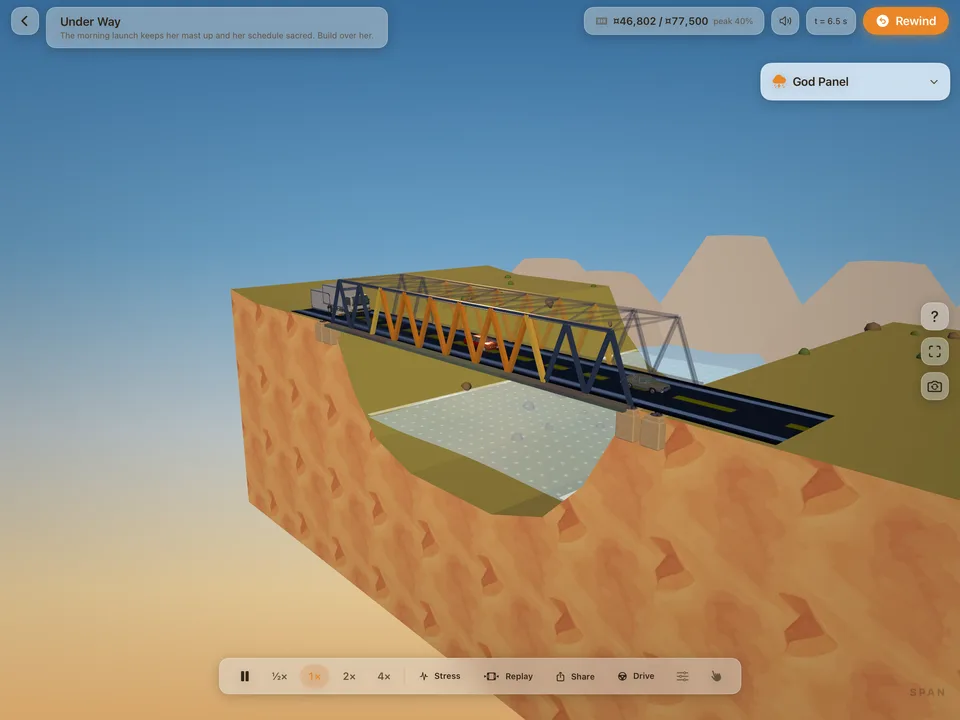
This one was an experiment with a game attached. I wanted to know how far a build could be parallelised across coding agents and still arrive as something finished — not a prototype with the interesting 80% done. A puzzle game is an unusually honest test: physics either behaves or it visibly does not, levels either solve or they do not, and a store review is a hard deadline that does not negotiate.
A bridge builder for iPhone, iPad and Mac. A deterministic structural solver written from scratch with no third-party dependencies, a live X-ray of tension and compression on every beam, 57 levels across eight worlds, and a level editor. Specified, directed and shipped in the margins of other work.
That the hard part of parallelising a build is not the agents. It is holding a coherent product in your head while several people who are not you work on different parts of it — which is the same problem as running a team, arriving sooner. It shipped, which was the whole point of the exercise.
Transcript
An agent I built. It answers from my résumé and the pages of this site — nothing else — and says so when it does not know.
It can also open and scroll to whatever it is describing, so the answer and the evidence arrive together.
Type a question, or press the mic and talk to it.
 Michael Gifford-Santos