
Launching in Hawaiʻi. Designed for everywhere.
Ask Leilani anything about where you are — where to eat, what to do, how to get there — and get real local answers, out loud, in your language. She's the front door to the platform behind her: partner listings matched on meaning, a taste profile that learns each traveler, bookings placed in-chat into partners' real systems, and attribution that proves every referral. Brand, character, app, and platform — all of it mine.
Brand · Product · Platform — JNSQ Labs
wunderguide.com →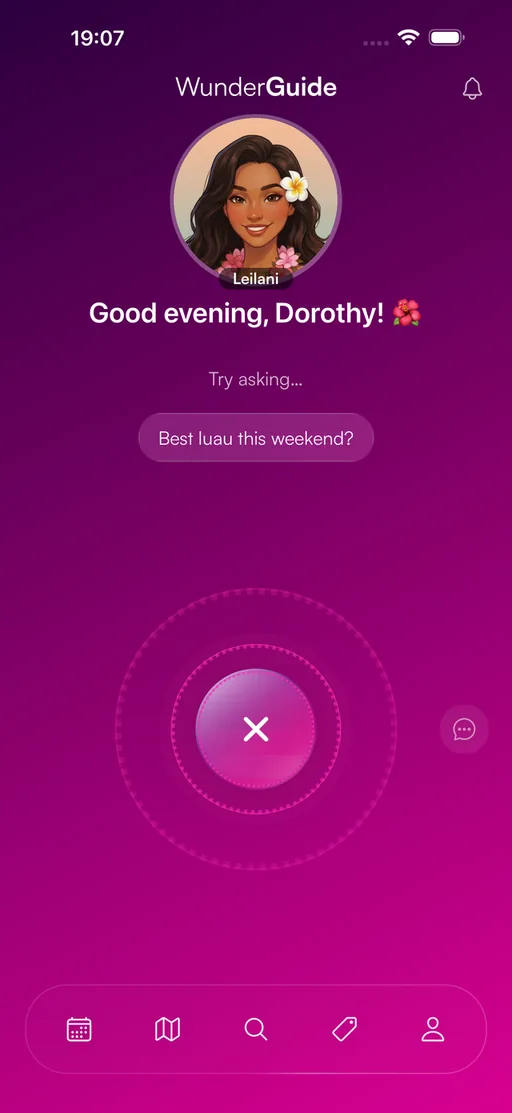
Travellers do not want a chatbot. They want an answer about the day they are actually having — which means grounding in live state: the itinerary, where they are standing, how long it really takes to get somewhere, the weather on the way. And it means voice, which is unforgiving. A conversation dies above a few hundred milliseconds of awkwardness, so every enrichment had to fit inside a real-time budget. Grounding freshness and turn latency traded against each other explicitly, rather than by accident.
Co-founded with a partner who leads go-to-market; we work the product together near-daily. Engineering, product design, brand and the infrastructure are mine.
The agent is the smaller half of the work. Paid users were once not credited because webhooks went missing in flight — money and entitlement disagreed, and the app was the last to find out. What followed is the part that makes it a product rather than a demo: signature verification on every event, server-side reconciliation, an admin make-whole API for when the two ledgers diverge, a health check every fifteen minutes that alerts the moment the purchase-to-grant path degrades, and a written postmortem with replay tooling. Store operations, monitoring and incident response are the rest of it.
Live in the App Store and Google Play, launched Hawai‘i-first, and early. The growth numbers that would turn this into a different kind of story are not mine to quote yet.
Transcript
An agent I built. It answers from my résumé and the pages of this site — nothing else — and says so when it does not know.
It can also open and scroll to whatever it is describing, so the answer and the evidence arrive together.
Type a question, or press the mic and talk to it.
 Michael Gifford-Santos